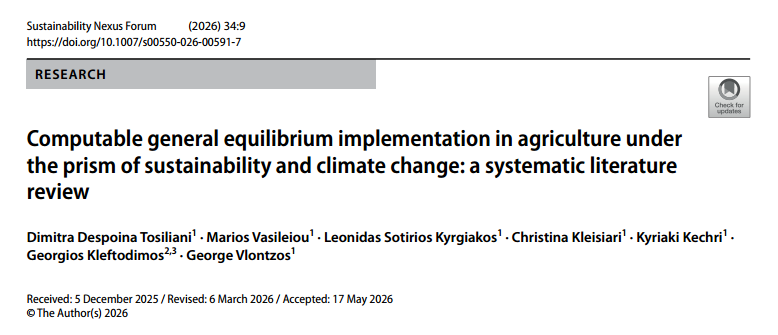
A new open-access paper has been published in Sustainability Nexus Forum, a journal of Springer. The paper examines how well Computable General Equilibrium (CGE) models — economy-wide simulators that trace how a shock in one sector propagates through all the others — capture sustainability in agriculture under climate change.
Following PRISMA guidelines, the authors assessed 131 full texts from an initial pool of 9,673 documents and included 115 studies published between 2009 and 2024, coded against 30 criteria across eight thematic categories.
Coverage proves uneven. CGE applications evaluate economic impacts in 97% of studies, well ahead of environmental (54%) and social (43%) dimensions, and only nine studies internalise all four WEFE pillars within a single framework. A cross-analysis using Fisher’s exact test identifies food security as the connective tissue of the framework, significantly linked to both environmental (p = 0.013) and social impacts (p = 0.037), while water management emerges as a cross-cutting driver tied to no single pillar.
Ultimately, the paper recommends coupling CGE models with Agent-Based Modelling, machine learning and artificial intelligence, so that farmer behaviour and localised technology adoption can finally be represented.
Full paper: Computable general equilibrium implementation in agriculture under the prism of sustainability and climate change: a systematic literature review (open access)